Elixir
Configuration Example
[project]name      = "my-elixir-app"root      = "."languages = ["elixir"]
[resolve.elixir]app_name = "MyApp"
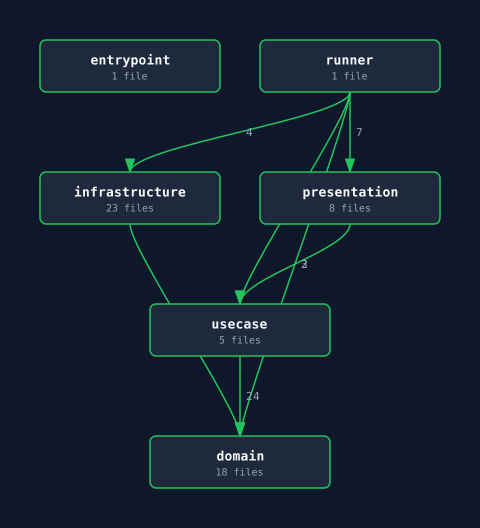
[[layers]]name            = "domain"paths           = ["lib/domain/**"]dependency_mode = "opt-in"allow           = []external_mode   = "opt-out"external_deny   = []
[[layers]]name            = "usecase"paths           = ["lib/usecase/**"]dependency_mode = "opt-in"allow           = ["domain"]external_mode   = "opt-out"external_deny   = []
[[layers]]name            = "infrastructure"paths           = ["lib/infrastructure/**"]dependency_mode = "opt-out"deny            = []external_mode   = "opt-out"external_deny   = []
app_name Setting
Set [resolve.elixir] app_name to the PascalCase module name corresponding to :app in mix.exs (e.g. MyApp).
[resolve.elixir]app_name = "MyApp" # when :app is :my_app in mix.exsImport Classification
All four Elixir directives are analyzed as dependencies.
| Directive | Example | Classification |
|---|---|---|
alias | alias MyApp.Domain.User | Internal (matches app_name) |
alias with as: | alias MyApp.Domain.User, as: U | Internal |
import | import Enum | External |
require | require Logger | External |
use | use Ecto.Schema | External |
Module-to-Path Resolution
Internal module paths are resolved using the following rule:
MyApp.Domain.User → strip app_name → Domain.User → lowercase → lib/domain/user.ex
Unsupported Features
allow_call_patterns is not supported for Elixir. Because Elixir uses dynamic dispatch, static receiver-type inference is not reliable.