mille init
Overview
mille initmille init ./path/to/project # specify target directoryAnalyzes import statements in your source files to infer layer structure and dependencies, then generates mille.toml. You can pass a project directory as a positional argument. Defaults to the current directory (.) if omitted.
Options
| Flag | Default | Description |
|---|---|---|
--output <path> | mille.toml | Write config to a custom path |
--force | false | Overwrite an existing file without prompting |
--depth <N> | auto | Layer detection depth from project root |
Auto-depth Detection
mille init tries depths 1–6, skips common source-layout roots (src, lib, app, etc.), and selects the first depth that yields 2–8 candidate layers.
For a project with src/domain/entity, src/domain/repository, src/usecase/ — depth 2 is chosen, rolling entity and repository up into domain.
Use --depth N to override.
Example Output
Detected languages: rustScanning imports...Using layer depth: 2
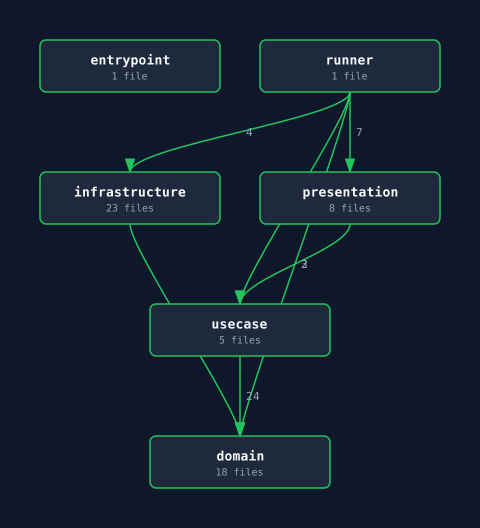
Inferred layer structure:  domain               ← (no internal dependencies)  usecase              → domain    external: anyhow  infrastructure       → domain    external: serde, tokio
Generated 'mille.toml'
Monorepo Naming
When multiple sub-projects contain the same directory name (e.g. crawler/src/domain and server/src/domain), mille init adds a distinguishing prefix (crawler_domain, server_domain). Merging is left to you.
Language-specific Auto-detection
| Language | Auto-detected |
|---|---|
| Go | Reads go.mod and generates [resolve.go] module_name |
| Python | Detects src/ layout and adds src to package_names |
| Java/Kotlin | Reads pom.xml / build.gradle + settings.gradle for module_name |